


CompTIA Certification Requirements: Eligibility, Costs, and Exam Details
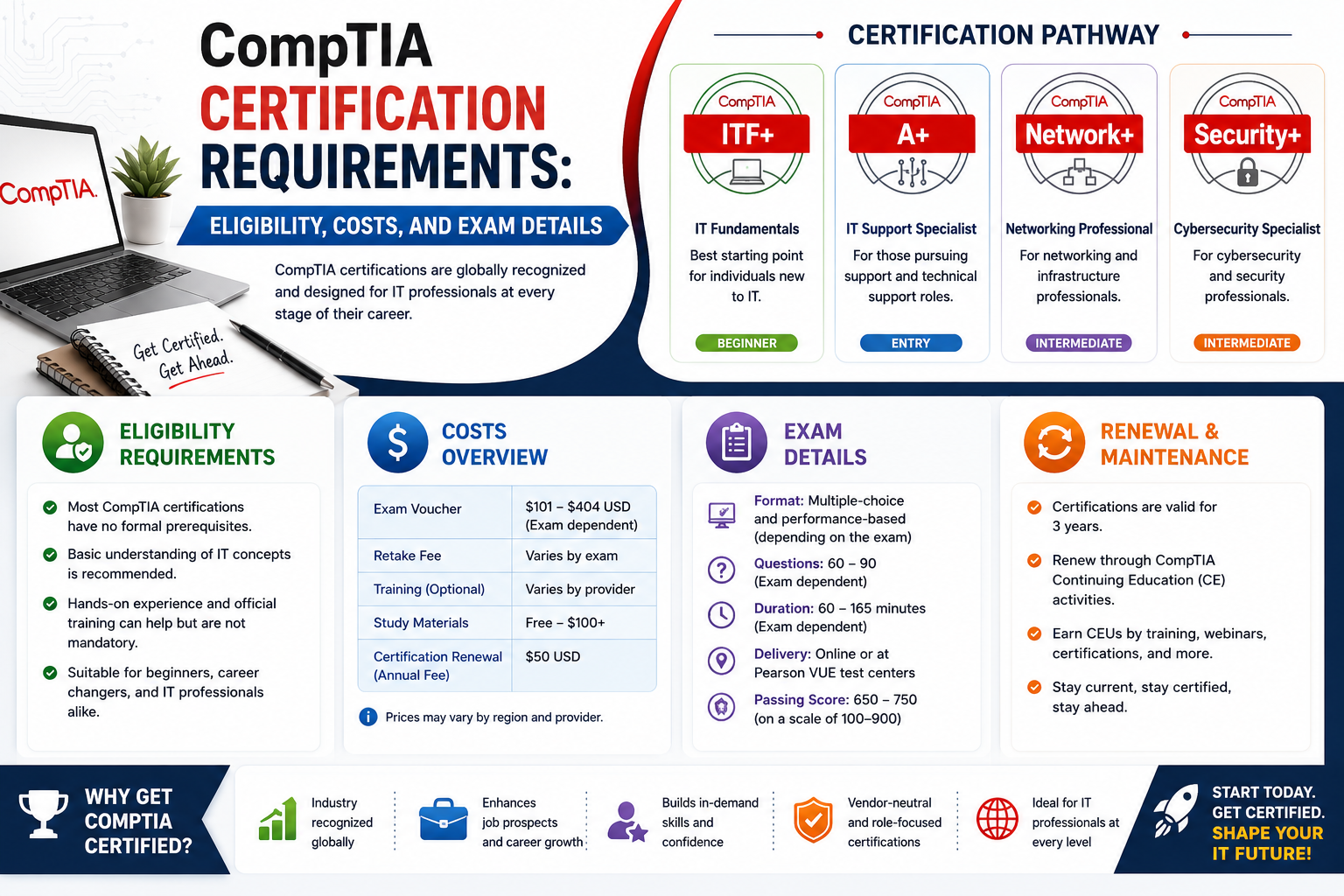
CompTIA certifications are among the most recognized vendor-neutral IT credentials in the world. Whether you want to begin a career in technical support, networking, cybersecurity, cloud computing, or data management, CompTIA offers certifications that validate practical skills employers value across many industries.
One of the reasons CompTIA certifications are so popular is their flexibility. Most exams do not require formal education, previous certifications, or mandatory training courses. Instead, candidates are encouraged to gain the recommended knowledge and practical experience before attempting an exam.
If you're planning to earn your first CompTIA certification, understanding the eligibility requirements, exam costs, registration process, and certification policies will help you prepare with confidence. This guide explains everything you need to know before scheduling your exam.
What Are CompTIA Certifications?
CompTIA develops vendor-neutral certifications that focus on practical IT skills rather than a specific technology vendor.
Its certification pathway covers multiple career areas, including:
-
IT Fundamentals
-
Technical Support
-
Networking
-
Cybersecurity
-
Cloud Computing
-
Linux Administration
-
Data Analytics
-
Penetration Testing
-
Security Operations
-
Advanced Security
Because the certifications are vendor-neutral, the knowledge gained can be applied across many technology environments rather than a single platform.
Are There Any Eligibility Requirements?
One of the biggest advantages of CompTIA certifications is that most exams have no mandatory eligibility requirements.
In general:
-
No college degree is required.
-
No previous certification is required.
-
No mandatory training course is required.
-
Candidates can register directly for an exam.
However, CompTIA publishes recommended experience for many certifications. For example, entry-level certifications are suitable for beginners, while intermediate certifications such as Security+, CySA+, PenTest+, Cloud+, and Linux+ assume candidates already possess foundational IT knowledge and some practical experience.
Following these recommendations usually improves your chances of passing the exam on the first attempt.
CompTIA Certification Levels
CompTIA certifications are designed to support different stages of an IT career.
|
Certification Level |
Typical Focus |
Intended Audience |
|
Foundational |
Basic IT concepts |
Beginners and students |
|
Core |
IT support, networking, security |
Entry-level IT professionals |
|
Infrastructure |
Networking, Linux, cloud |
System and network administrators |
|
Cybersecurity |
Defensive and offensive security |
Security professionals |
|
Professional |
Advanced enterprise security |
Experienced IT specialists |
This structured pathway allows professionals to build knowledge gradually while progressing into more specialized roles.
Exam Costs
CompTIA exam pricing varies depending on the certification and the candidate's country or region.
Higher-level certifications generally cost more than entry-level exams, and prices may change periodically. Regional taxes, currency conversion, and promotional discounts can also affect the final amount.
When planning your budget, consider additional expenses such as:
-
Practice tests
-
Study guides
-
Training courses (optional)
-
Retake vouchers (optional)
Always verify the latest pricing before purchasing an exam voucher because CompTIA periodically updates exam fees.
Exam Format
Although every certification has its own objectives, most CompTIA exams follow a similar structure.
Candidates can expect:
-
Multiple-choice questions
-
Performance-Based Questions (PBQs) for many technical certifications
-
Scenario-based problem solving
-
Computer-based testing
-
Timed examinations
Performance-Based Questions evaluate practical decision-making by presenting realistic technical situations rather than simple factual questions.
This approach allows employers to have greater confidence that certified professionals can apply their knowledge in workplace environments.
Registration Process
Scheduling a CompTIA certification exam is straightforward.
The typical process includes:
-
Create a CompTIA account.
-
Select your desired certification.
-
Purchase an exam voucher.
-
Schedule your examination.
-
Choose online testing or an authorized testing center.
-
Complete identity verification before the exam.
Candidates should review the exam policies and technical requirements carefully before scheduling, especially if choosing online proctored testing.
Certification Renewal
Most modern CompTIA certifications participate in the Continuing Education (CE) program.
Rather than remaining valid indefinitely, certifications typically require renewal every three years. Professionals can maintain their certification by earning approved Continuing Education Units (CEUs), completing qualifying training, or earning higher-level CompTIA certifications.
This renewal process helps ensure certified professionals remain current with evolving technologies and industry practices.
How to Choose the Right Certification
Selecting the appropriate certification depends on your current experience and career goals.
If you are new to IT, foundational or core certifications provide an excellent starting point.
Professionals interested in networking may progress toward Network+, while those pursuing cybersecurity often begin with Security+ before advancing to CySA+ or PenTest+. Cloud professionals may choose Cloud+, and Linux administrators can specialize through Linux+.
Understanding your desired career path before selecting a certification helps create a more effective long-term learning plan.
Preparation Tips
Successful candidates typically combine theoretical learning with practical experience.
A structured preparation strategy should include:
-
Reviewing every published exam objective.
-
Building hands-on technical experience.
-
Completing realistic practice exams.
-
Revising weaker topics regularly.
-
Practicing time management.
Practical laboratories often provide significantly greater learning value than memorizing answers because many CompTIA exams evaluate applied knowledge.
Many candidates also strengthen their preparation using updated practice questions, realistic mock exams, and structured study resources available through Cert Mage alongside their regular study plan.
Why CompTIA Certifications Remain Valuable
Technology continues changing rapidly, but organizations still need professionals with strong technical foundations.
Vendor-neutral certifications remain attractive because they demonstrate transferable skills that apply across many technology environments. Employers frequently recognize CompTIA certifications when hiring for technical support, networking, cybersecurity, cloud, and infrastructure positions.
Combined with practical experience, these certifications can strengthen your professional profile and support long-term career development.
Conclusion
CompTIA certifications offer a flexible pathway into information technology by allowing candidates to earn respected credentials without mandatory education or prerequisite certifications. Understanding the eligibility recommendations, exam format, costs, registration process, and renewal requirements helps candidates prepare effectively before scheduling their first exam.
Whether you are beginning your IT career or expanding existing technical skills, choosing the right CompTIA certification and following a structured preparation plan can provide a strong foundation for future professional growth.
FAQs
Do CompTIA certifications require previous certifications?
No. Most CompTIA certifications do not require previous certifications. Candidates can register directly, although CompTIA recommends appropriate experience for many intermediate and advanced certification exams.
Are CompTIA exams available online?
Yes. Most CompTIA certification exams can be taken through online proctoring or at authorized testing centers, allowing candidates to choose the testing method that best suits them.
How long are CompTIA certifications valid?
Most modern CompTIA certifications remain valid for three years and can be renewed through the Continuing Education program or by meeting approved renewal requirements.
Do all CompTIA exams include performance-based questions?
Many technical certifications include Performance-Based Questions that evaluate practical problem-solving skills, although the exact exam format varies depending on the specific certification.
Which CompTIA certification should beginners choose?
Beginners typically start with foundational or core certifications that introduce essential IT concepts before progressing toward networking, cybersecurity, cloud computing, or other specialized career paths.
Learn More: https://abhira.in/blogs/108353/CySA-vs-Security-Complete-Comparison-for-Beginners-and-IT-Professionals

 English
 Arabic
 French
 Spanish
 Portuguese
 Deutsch
 Turkish
 Dutch
Dutch
 Italiano
 Russian
 Romaian
 Greek
Greek