


Why Regional Language Content Is the Untapped Gold Mine in the Micro Drama Market
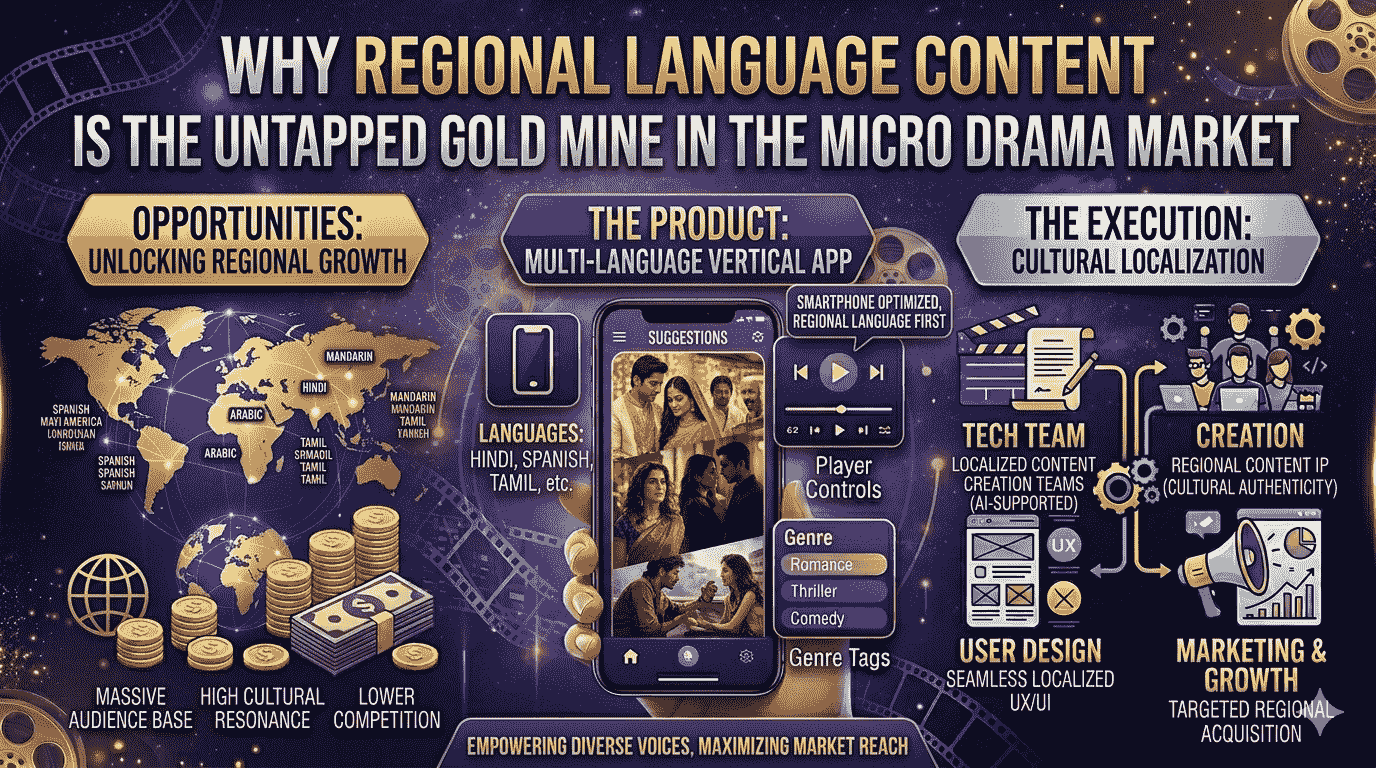
The micro drama industry has produced some of the most impressive growth numbers in digital entertainment over the last three years. Platforms are scaling fast, revenues are climbing, and user engagement metrics are beating traditional streaming by a significant margin. Yet for all this momentum, the industry has a glaring blind spot — and it represents one of the largest untapped opportunities in the entire streaming market.
Regional language content is almost entirely absent from the micro drama space.
While platforms like DramaBox and ReelShort have dominated English-language and Mandarin-language markets, billions of potential viewers across South Asia, Southeast Asia, the Middle East, Latin America, and Africa are consuming entertainment in languages that the major platforms have either ignored or addressed poorly with rushed translations. These audiences are not a secondary market. They are the majority of the global mobile internet population — and right now, nobody is building micro drama for them seriously.
That gap is where the next generation of streaming businesses will be built.
The Scale of What Is Being Ignored
Consider the numbers. India alone has over 22 officially recognized languages and hundreds of dialects, with massive media-consuming populations in Hindi, Tamil, Telugu, Bengali, Marathi, Kannada, and Malayalam. Indonesia has over 270 million people and a dominant Bahasa Indonesia-speaking population with virtually no dedicated micro drama platform. The Arabic-speaking world spans 25 countries and 400 million people. Spanish-speaking Latin America has over 650 million potential users.
These are not niche markets. They are continental-scale audiences with high mobile penetration, strong appetite for drama content, and almost no competition in the micro drama format.
The businesses that move into these markets now are not fighting for scraps. They are walking into rooms that are almost completely empty.
Why Regional Audiences Are Underserved — And Why That Is About to Change
The reason regional language micro drama has been slow to develop is not lack of demand. It is a supply problem rooted in how the major platforms were built.
DramaBox and ReelShort were designed for English-speaking and Mandarin-speaking audiences first. Their content acquisition strategies, their recommendation algorithms, their marketing playbooks — all of it was built around those core markets. Expanding into regional languages is not simply a matter of translating subtitles. It requires understanding cultural storytelling preferences, building relationships with regional content creators, and often rebuilding parts of the product experience to serve audiences whose viewing habits differ meaningfully from Western or East Asian users.
For a large platform already managing millions of users, that kind of regional pivot is slow and expensive. For a new business built specifically for a regional market, it is a natural starting point — and a genuine competitive advantage.
Regional content creators already exist in every one of these markets. Writers, directors, and producers who understand their audiences deeply are actively looking for distribution platforms. The infrastructure for regional micro drama is closer to ready than most people realize. What is missing is the platform itself.
The Pain Points Regional Content Businesses Face Today
No platform built for their audience Regional content creators and media businesses have nowhere purpose-built to distribute short-form drama in their language. The options are either global platforms that treat regional content as an afterthought or long-form streaming services that are not designed for micro drama economics at all.
Translation is not localization Platforms that attempt to serve regional markets by dubbing or subtitling English content miss the point entirely. Audiences do not just want content in their language — they want stories that reflect their culture, their social dynamics, their humor, and their emotional reference points. A Hindi-speaking audience in Uttar Pradesh and an English-speaking audience in New York want fundamentally different stories, even if the drama format is the same.
Monetization systems that do not fit regional payment behavior The coin and subscription models that work in North America do not translate directly to markets where credit card penetration is low and users are accustomed to UPI payments, digital wallets, or carrier billing. A platform built for a regional market needs a monetization layer that reflects how people in that market actually pay for things.
Content discovery built for the wrong audience Recommendation algorithms trained on Western viewing behavior will not serve regional audiences well. A platform serious about a specific regional market needs content discovery and personalization built around that audience's actual consumption patterns — not a global average.
What a Regional Micro Drama Platform Actually Needs
Building for a regional market is not the same as building a generic streaming app and adding a language option. The most successful regional platforms will be built with the following in mind from day one.
Culturally relevant content strategy The platform's content library needs to be built around stories that resonate with the target audience. This means working directly with regional writers and production teams, not adapting content created for another market. The most engaging micro drama taps into universal emotions — love, betrayal, ambition, family — but expresses them through culturally specific contexts that the audience recognizes as their own.
Localized monetization Payment integration needs to reflect regional behavior. In India, this means UPI and popular wallets. In Southeast Asia, it means GoPay, OVO, or GrabPay depending on the market. In the Middle East, it means supporting local card networks and cash-based digital payment systems. Getting this wrong is not a minor inconvenience — it is a conversion killer.
Language-first UI and UX The entire product experience — onboarding, navigation, content descriptions, push notifications, customer support — needs to be in the user's language natively, not as a translated overlay on top of an English-first design. Right-to-left language support for Arabic markets, for example, requires architectural decisions that cannot be retrofitted easily after launch.
Regional content creator tools If the platform wants a steady supply of regional content, it needs to make it easy for regional creators to upload, manage, and monetize their series. A CMS built for a production house in Los Angeles will not work for an independent creator in Chennai or Jakarta. The tools need to match the technical capacity and workflow of the creators the platform is trying to attract.
This is where investing in the right vertical micro drama app development partner makes the difference between a platform built to scale and one that hits a ceiling within the first year.
The First-Mover Advantage Is Real and It Is Time-Limited
In established streaming markets, first-mover advantage is often overstated. Netflix had competitors that caught up. Spotify had Apple Music right behind it. But in regional language micro drama, the first-mover advantage is genuinely significant — for one specific reason.
Content libraries take time to build.
A platform that launches in the Tamil-language market today and spends the next 18 months building relationships with Tamil writers, directors, and production houses will have a catalog and a creator network that a competitor entering two years later cannot replicate quickly. Content is a moat in streaming. The earlier you start building it, the harder it becomes for anyone else to displace you.
User habits are also sticky in entertainment. When a viewer finds a platform they love — one that speaks their language, tells stories that feel familiar, and releases content they are excited about — switching costs are high. The platform that earns that loyalty first keeps it.
Why This Market Rewards Focused Businesses Over Large Platforms
There is a counterintuitive truth about regional language micro drama: large global platforms are actually at a disadvantage here.
A global platform serving 50 markets cannot give any single regional market the focused attention it needs to win that market. Content acquisition decisions are made centrally. Product localization is deprioritized in favor of features that serve the majority of the user base. Marketing budgets go where the largest existing audiences are.
A business built specifically for one regional market — with deep cultural knowledge, local creator relationships, and a product designed for that audience from the ground up — can outcompete a global platform in that market even with a fraction of the resources.
This is the same dynamic that allowed regional e-commerce platforms to outperform Amazon in several Southeast Asian markets. Local knowledge and focused execution beat scale when the product needs to be genuinely local to work.
For entrepreneurs and media businesses with roots in a specific regional market, this is an enormous structural advantage. Businesses looking to move fast with a proven foundation can explore a DramaBox clone approach — a white-label solution that handles the core technology while the business focuses entirely on content and community.
The Window Is Open — But Not Forever
The regional language micro drama opportunity exists right now because the major platforms have not prioritized it. That will change. As the global platforms mature and look for new growth markets, regional language content will move up their priority list. When it does, the cost of entry for independent businesses will rise and the available market share will shrink.
The businesses that are already in market by then — with established content libraries, loyal user bases, and deep creator relationships — will be the ones that either dominate their regional niche or become acquisition targets for the platforms that arrive late.
Either outcome is a strong result for a business that moved early.
Regional language micro drama is not a secondary opportunity waiting for the primary market to mature. It is a primary opportunity in its own right — one that is available right now to businesses with the vision to see it and the decisiveness to act on it.

 English
 Arabic
 French
 Spanish
 Portuguese
 Deutsch
 Turkish
 Dutch
Dutch
 Italiano
 Russian
 Portuguese (Brazil)
 Greek
Greek