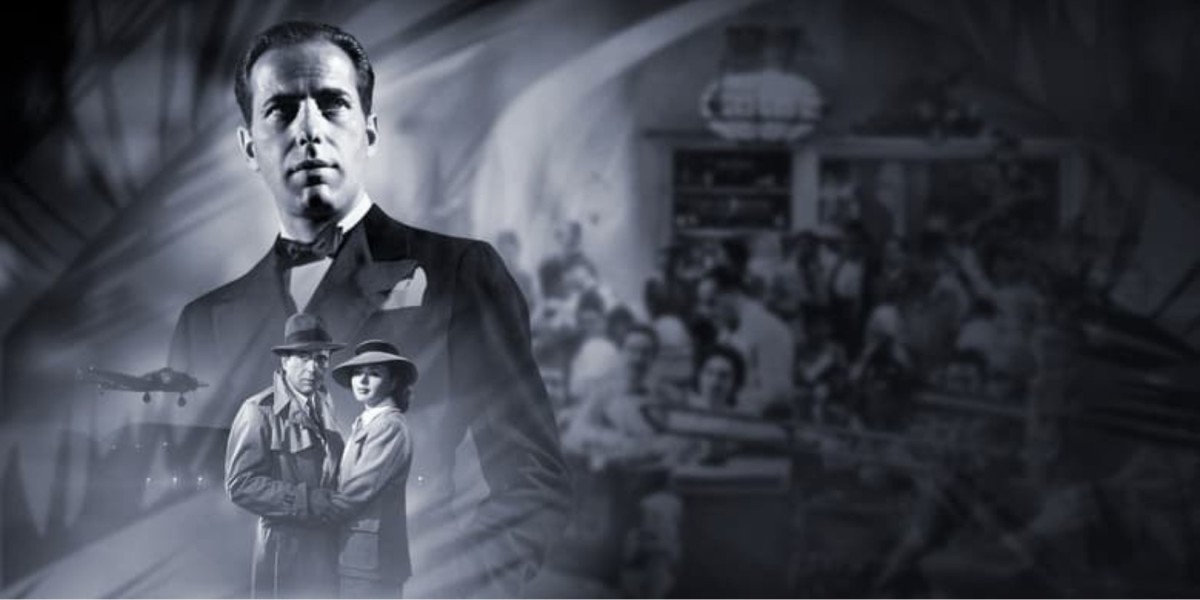
Few films carry the historical and emotional weight of Casablanca (1942). This timeless cinema classic not only marked a generation but also became eternal as a symbol of impossible love in times of war. Produced during the Second World War, for a long time there is a reference in the right direction, direction and performance.
Production and Frames
Casablanca was produced by Warner Bros. and directed by Michael Curtiz, with filming beginning in May 1942, ending in July of the same year — in other words, a relatively quick production of just three months. The official launch occurred on November 26, 1942, in New York, with national broadcast in 1943.
Curiously, the plot was still being written during the filming, which led the actors to discover the fate of their characters at the same time as the public. The story was based on the unpublished theatrical piece Everybody Comes to Rick's, purchased by the studio for US$20,000 — a very high value for a piece not published at the time.
Memorável Cast
The film stars Humphrey Bogart as Rick Blaine, a cynical dono from a bar in Casablanca, and Ingrid Bergman as Ilsa Lund, her great love from the past. Beside them is:
Paul Henreid as Victor Laszlo, the hero of Czech resistance;
Claude Rains as Captain Renault, with his inescapable moral ambiguity;
Dooley Wilson as Sam, or pianist who eternalized the phrase “Play it, Sam.”
Where was it filmed?
Despite its exotic setting in Casablanca, not Morocco, the film was entirely shot at Warner Bros. studios in Burbank, California. The limitations of war and the resources of the era impede filming in international locations. Furthermore, the art director managed to create a convincing and enveloping atmosphere.
Bilheteria e Reconhecimento
Released during the war, Casablanca was a blockbuster success, earning around US$3.7 million in just the United States — an expressive value for the fathers of the era. More important was its cultural impact: the film won three Oscars in 1944, including Best Film, Best Director and Best Director Adapted.
Curiosities
The iconic phrase “Here's looking at you, kid” was improvised by Humphrey Bogart.
Ingrid Bergman filmed without knowing how her character would end, because the end was still not decided.
The theme music “As Time Goes By” was removed from the film — but since Bergman had already cut his hair for another role, refilming would be impossible.
The film gained the status of “absolute classic” in the following years, with the film being considered one of the two greatest films of all time by the American Film Institute.
✨ Why does Casablanca still matter?
Casablanca transcends its era by telling of difficult choices, sacrifices and loves that defy logic. In times of war or peace, his message remains current. It is a name that cinema can touch souls, inspire generations and make history — square by square, note by note, smell by smell.
Want more curiosities about cinema classics? Follow SetWonder and continue exploring the best seventh art with people!